You Won’t Believe These Hidden Architectural Gems in Hiroshima
Hiroshima isn’t just a city of history—it’s a visual story told through steel, glass, and stone. I went there chasing light and shadows, and found myself stunned by how modern design quietly honors the past. From serene temples to bold contemporary buildings, every structure felt intentional. If you’re into photography and love capturing soulful architecture, Hiroshima will surprise you in the best way possible.
The Soul of a Reborn City: Architecture as Memory
Hiroshima’s cityscape is more than a collection of buildings—it is a living testament to resilience, rebirth, and thoughtful design. After the devastation of 1945, urban planners faced the immense task of rebuilding not just structures, but a sense of identity. The city’s layout was reimagined with wide boulevards, expansive green spaces, and deliberate sightlines that balance remembrance with renewal. These open corridors were not merely practical; they were symbolic—designed to prevent the spread of fire and to create a breathable, human-centered environment. This intentional spacing also makes Hiroshima an ideal destination for architectural photographers, offering unobstructed views and natural framing for wide-angle lenses.
At the heart of this vision lies the city’s central axis, which leads directly to the Peace Memorial Park. This alignment is no accident. It reflects a philosophical commitment to peace and transparency, where the skyline is never dominated by towering commercial buildings. Instead, low-rise structures and public spaces dominate, creating a skyline that feels approachable and dignified. The city’s master plan prioritized accessibility and tranquility, ensuring that even as Hiroshima grew into a modern metropolis, it retained a human scale. This balance between progress and reverence is evident in the careful placement of memorials, parks, and civic buildings, all contributing to a harmonious urban rhythm.
For visitors, this means every walk through central Hiroshima is a journey through layers of meaning. The architecture does not shout; it whispers. The use of open plazas, reflective surfaces, and uncluttered streetscapes invites contemplation. Photographers will find that the city’s design naturally guides the eye toward focal points—whether it’s the distant silhouette of the Atomic Bomb Dome or the gentle curve of a pedestrian bridge over the Motoyasu River. In this way, Hiroshima’s urban fabric becomes a silent narrator, guiding both residents and visitors through a story of loss, recovery, and hope.
Peace Memorial Park: Where Design Meets Emotion
The Peace Memorial Park stands as one of the most powerful examples of architecture serving as emotional language. Designed by Kenzo Tange, a pioneer of modernist Japanese architecture, the park is a masterclass in minimalism, symmetry, and spatial storytelling. Its structures are not ornate, but their simplicity amplifies their impact. The Cenotaph for the A-Bomb Victims, with its arched concrete form, frames both the Atomic Bomb Dome and the Peace Flame, creating a visual and spiritual axis that connects past and present. This intentional alignment allows photographers to capture layered compositions—where memory, monument, and nature converge in a single frame.
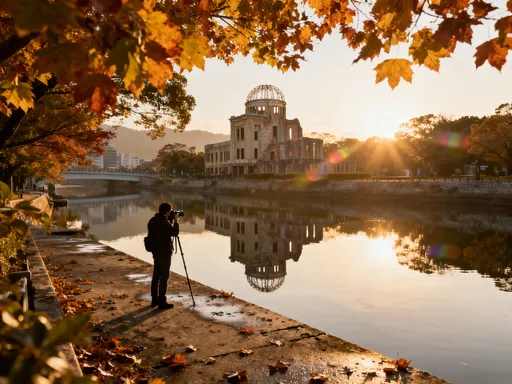
One of the most striking moments to photograph the Atomic Bomb Dome is during golden hour, when the low sunlight casts long shadows across the river and bathes the ruined façade in warm, amber light. The contrast between the dome’s skeletal remains and the soft glow of sunset creates a poignant duality—destruction illuminated by hope. Reflections in the still waters of the surrounding moat double the impact, offering mirror images that deepen the sense of solemnity. Using a polarizing filter can help reduce glare and enhance the clarity of these reflections, allowing for a more immersive visual experience.
The park’s integration with nature further enhances its emotional resonance. Rows of zelkova trees line the pathways, their canopies forming natural arches that guide visitors toward the memorials. In spring, cherry blossoms bloom along the riverbanks, their delicate pink petals offering a gentle contrast to the solemnity of the structures. Photographers can use these trees as natural frames, shooting through branches to create depth and symbolism. The interplay of light and shadow beneath the foliage adds texture to images, turning simple shots into evocative narratives. Every element in the park—from the placement of benches to the flow of footpaths—has been designed to encourage reflection, making it not just a place to visit, but a space to feel.
Modern Icons: Hiroshima’s Contemporary Buildings
While Hiroshima is deeply rooted in history, its architectural story continues to evolve through bold contemporary designs. The Hiroshima City Museum of Contemporary Art, nestled in a quiet corner of the city, exemplifies this forward-looking spirit. Its angular concrete forms and expansive glass facades create a dialogue between solidity and transparency. The building’s exterior reflects the changing sky, shifting in color and tone throughout the day. Early morning light softens its edges, while midday sun emphasizes its geometric precision. For photographers, this offers endless opportunities to capture the interplay of light, shadow, and materiality.
Another standout is the Hiroshima Prefectural Art Museum, located near the Shukkeien Garden. Its design blends modern minimalism with subtle nods to traditional Japanese aesthetics. The use of natural stone, wooden accents, and flowing interior spaces creates a sense of continuity between old and new. The museum’s exterior features a series of horizontal lines that echo the surrounding landscape, grounding the structure in its environment. When photographing such buildings, it’s effective to use leading lines—such as the edge of a walkway or the curve of a staircase—to draw the viewer’s eye toward the main façade. Wide-angle lenses can capture the full scale of these structures, while telephoto shots can isolate interesting details like textured walls or reflective glass panels.
The Hiroshima City Hall complex is another example of how civic architecture can be both functional and expressive. Its sleek glass towers rise above the city center, yet their design avoids overwhelming the skyline. At night, the building is softly illuminated, creating a glowing landmark without ostentation. Photographers can capture its presence from the adjacent plaza, using long exposures to record the movement of people and light. The contrast between the building’s modernity and the surrounding low-rise structures highlights Hiroshima’s unique urban balance—where innovation respects memory.
Temples and Shrines: Traditional Elegance in a Modern City
Amid Hiroshima’s modern skyline, traditional temples and shrines offer quiet retreats of architectural beauty. Mitaki-dera, a Buddhist temple nestled in the forested hills, is a prime example. Built on steep slopes, its wooden halls are connected by stone steps and wooden bridges, creating a vertical journey through nature and spirituality. The temple’s main hall features classic elements of Japanese temple architecture: curved tiled roofs, intricately carved wooden brackets, and deep eaves that shelter visitors from rain and sun. These eaves also create dramatic patterns of light and shadow, especially in the late afternoon when sunlight filters through the trees.
Close-up photography reveals the craftsmanship behind these structures—the chisel marks on wooden beams, the texture of aged thatch, the subtle color variations in roof tiles. A macro lens can capture the delicate details of guardian statues, lantern engravings, and weathered door hinges, each telling a story of time and devotion. In autumn, the surrounding maple trees turn brilliant shades of red and gold, framing the temple in a natural palette that changes daily. This seasonal transformation makes Mitaki-dera a rewarding destination for repeat visits, as each month offers a new visual narrative.
Hijiyama Shrine, perched on a hilltop with panoramic views of the city, presents a different kind of beauty. Its bright red torii gate stands in contrast to the greenery, creating a striking focal point for photographs. The shrine’s layout follows traditional Shinto principles, with a clear path leading from the entrance to the main hall, symbolizing the journey from the mundane to the sacred. The wooden structures are elevated on stilts, protecting them from moisture and adding to their elegance. Photographers can use the elevation to their advantage, capturing the shrine from below to emphasize its prominence, or from above to show its relationship with the landscape. The play of morning mist through the trees adds a mystical quality, especially in early summer.
Off-the-Beaten-Path Neighborhoods: Hidden Facades and Local Life
Beyond the well-trodden tourist routes, Hiroshima’s backstreets reveal a quieter, more intimate side of the city. In Naka-ku and other central districts, narrow lanes wind between old merchant houses, family-run shops, and mixed-use buildings that blend living spaces with small businesses. These neighborhoods have not been over-restored; their charm lies in their authenticity. Weathered wooden walls, rusted metal shutters, and hand-painted signs tell stories of decades of daily life. For photographers, these streets offer a treasure trove of textures, colors, and candid moments.
One of the most photogenic areas is the retro shopping arcade near Kamiyachō, where low-rise buildings with tiled roofs house everything from tea shops to hardware stores. The facades are a mix of traditional and mid-century modern design, with large glass windows and decorative ironwork. Early morning is the best time to explore, when the light is soft and the streets are still quiet. Shop owners may be seen setting up displays or sweeping the sidewalks, offering opportunities for respectful street photography. The key is to be unobtrusive—using a small camera or smartphone, waiting for natural moments, and always asking permission if photographing people directly.
Another hidden gem is the old residential area near Hijiyama, where traditional Japanese houses with sliding paper doors and tiled roofs stand alongside modest concrete homes. These neighborhoods are not preserved as museums; they are lived-in, evolving spaces. Children play in front yards, laundry hangs from balconies, and potted plants decorate doorsteps. Capturing these everyday scenes requires patience and sensitivity. Rather than seeking perfection, photographers should look for authenticity—the slight tilt of a roof, the crack in a wall, the way light falls on a wooden step. These small details convey the soul of a place more powerfully than any grand monument.
Seasonal Shifts: How Light and Nature Transform Structures
Hiroshima’s architecture is not static; it changes with the seasons, offering a dynamic canvas for photographers throughout the year. In spring, cherry blossoms transform the city into a soft pink dreamscape. The Shukkeien Garden, with its teahouses and arched bridges, becomes a living painting, where delicate blossoms frame historic structures in fleeting beauty. Photographers can use shallow depth of field to isolate a single branch against a temple wall, or wide shots to capture the full sweep of blooming trees along the river. The brief bloom period—usually late March to early April—makes timing essential.
Summer brings deep greens and intense light. The foliage around temples becomes lush and dense, creating natural canopies that dapple sunlight across stone paths. Early morning fog often lingers in the hills, shrouding Mitaki-dera in mystery. This soft, diffused light is ideal for capturing mood and atmosphere. In contrast, midday sun can be harsh, but it also emphasizes the textures of concrete, wood, and stone. Using a lens hood or shooting in shaded areas can help manage contrast and avoid blown-out highlights.
Autumn is perhaps the most dramatic season. The maple trees around temples and parks turn fiery red, orange, and gold, creating vibrant backdrops for architectural photography. The contrast between the warm foliage and the cool tones of stone and metal is striking. Locations like the Peace Memorial Park and Hijiyama Shrine become especially photogenic, as the fall colors reflect in water features and frame historic structures. Winter, though quieter, offers its own beauty. On clear mornings, the city is bathed in crisp, clean light. Occasional morning mist rises from the rivers, softening the skyline and adding a sense of stillness. Snow is rare, but when it falls, even a light dusting can transform the city into a monochrome masterpiece.
Photography Tips: Capturing Hiroshima’s Architectural Spirit
To truly capture Hiroshima’s architectural essence, preparation and perspective are key. A versatile zoom lens (24-70mm) is ideal for most situations, allowing flexibility between wide cityscapes and tighter details. For low-light conditions—such as early mornings or indoor spaces—a tripod is invaluable. It enables longer exposures without blur, especially when photographing reflections in water or capturing the soft glow of illuminated buildings at night. A polarizing filter can enhance skies and reduce glare on glass and water, while a neutral density filter allows for creative long exposures during daylight, such as smoothing the flow of a river.
Composition plays a crucial role in conveying emotion. The rule of thirds can help balance a shot, but don’t be afraid to break it for dramatic effect. Leading lines—such as a row of trees, a bridge railing, or a pathway—can guide the viewer’s eye toward a focal point. Reflections, whether in puddles, moats, or glass surfaces, add depth and symmetry. Framing shots through natural elements like tree branches or temple gates can create a sense of intimacy and context. Always consider the story you want to tell: Is it the resilience of a rebuilt city? The quiet beauty of a hidden alley? The harmony between nature and design?
Post-processing should enhance, not alter. Adjusting contrast, white balance, and clarity can bring out the mood of a scene without over-saturating or distorting reality. Black-and-white editing can be particularly effective for historical sites, emphasizing texture and emotion. However, the most powerful images often require minimal editing—they capture a moment as it was, unfiltered and honest. Ultimately, the best photographs are not just technically sound, but emotionally resonant. They invite the viewer to pause, reflect, and feel.
Hiroshima’s architecture isn’t just about buildings—it’s about resilience, harmony, and the quiet beauty of renewal. Every photo you take here becomes part of a larger narrative. Pick up your camera, walk slowly, and let the city reveal its layers. You’ll leave not just with images, but with meaning.